Infrared reflective pigment
What is Infrared Reflective Pigment?
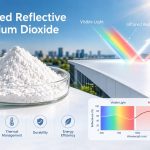
Infrared reflective pigment is a functional material designed to reflect near-infrared (NIR) radiation while maintaining desired visible color appearance. It is widely used in thermal management coatings to reduce heat buildup on surfaces exposed to sunlight.
Unlike traditional pigments that mainly control visible color, infrared reflective pigments focus on controlling solar energy absorption, especially in the infrared spectrum that contributes most to heat generation.
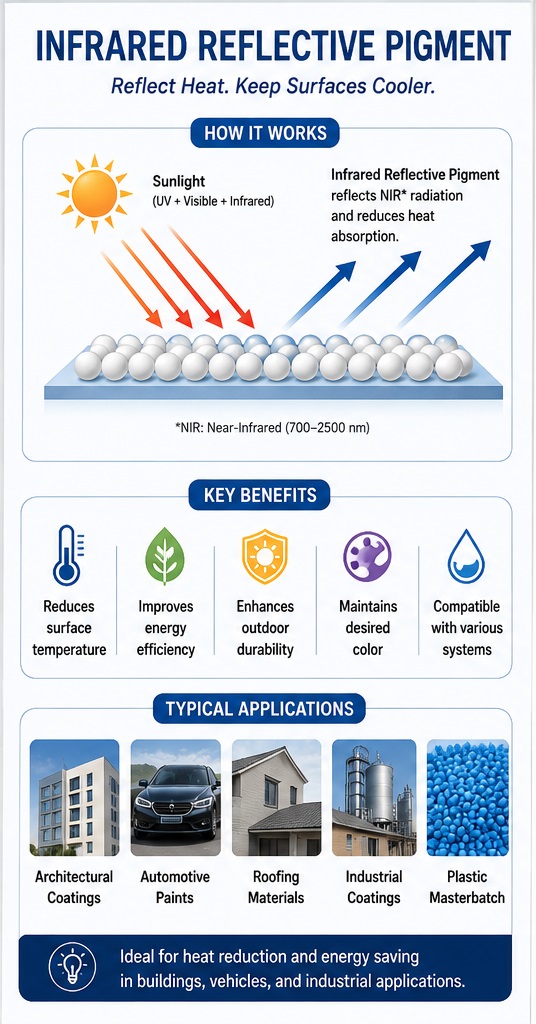
How It Works
Infrared reflective pigments work by selectively reflecting infrared wavelengths (typically 700–2500 nm) while allowing visible light to pass or be selectively absorbed depending on formulation. This helps reduce surface temperature without significantly altering color design.
Key Benefits
Excellent infrared reflection efficiency
Reduces surface temperature under sunlight
Improves energy efficiency in buildings and coatings
Enhances outdoor durability of coated materials
Compatible with water-based and solvent-based systems
Toepassingen
Infrared reflective pigments are widely used in:
Architectural exterior coatings
Automotive heat-reflective paints
Industrial protective coatings
Plastic masterbatches
Roofing materials and thermal insulation layers
Why Choose Infrared Reflective Pigments?
With rising demand for energy-saving and heat-reduction materials, infrared reflective pigments provide an effective solution for passive thermal control without requiring additional energy input.
Frequently Asked Questions
Q1: What is the main function of infrared reflective pigment?
Infrared reflective pigment is used to reflect near-infrared radiation from sunlight, helping to reduce heat buildup on surfaces while maintaining desired visible color.
Q2: Does infrared reflective pigment change the color of coatings?
It has minimal impact on visible color. It is designed to maintain color appearance while improving heat reflection performance.
Q3: What industries commonly use infrared reflective pigments?
They are widely used in architectural coatings, automotive paints, industrial coatings, roofing materials, and heat-reflective plastics.
Q4: Can infrared reflective pigments improve energy efficiency?
Yes. By reducing heat absorption, they can lower cooling energy consumption in buildings and vehicles.
Q5: Are infrared reflective pigments suitable for outdoor use?
Yes, they are designed for high durability and are commonly used in outdoor exposure environments.
👉 Contact us to discuss your application requirements.
gerelateerde producten
 Infrared cutoff pigment
- Infrared transmitting pigment
- Infrared Reflective Titanium Dioxide: Properties, Applications, and Buying Guide
- Visible light absorbing pigment
- Why Pigment Red 177 Is Ideal for Plastic Coloration and Masterbatch Manufacturing
- Pigment Red 177 Buying Guide: Everything Importers Need to Know Before Purchasing
- What Is Pigment Red 177? Properties, Applications, and Benefits Explained
- Pigment Red 146: Properties, Applications, and Technical Guide
- Pigment Red 177 Technical Data: Heat Resistance, Light Fastness, and Chemical Stability
- How to Choose the Right Pigment Yellow 97 for Plastics, Coatings, and Inks